Rachel Stephens explores the experience and role played by opponents to the Stroudwater Canal Scheme, including that of an ancestor, Daniel Chance of Dudbridge; his evidence to the Parliamentary Committee in 1776; and subsequent land negotiations with the Stroudwater Navigation Company.
For centuries, the Cotswold district played a pivotal role in the British woollen industry, and Stroud was a particularly important centre. The River Frome (or Stroudwater) provided essential water power for the mills. By 1730, there were more than a hundred mills involved in the industry, which lay within thirty miles of the town. When plans for the canal were first raised in the 1720s, the woollen industry in Stroud had been an economic success for over three hundred years.
In the mid-eighteenth century, thirty or so master clothiers in the Stroud area dominated the local industry. They recognised that the proposed canal scheme would improve communication and transport facilities, thereby enhancing their commercial success. They were, therefore, willing to inject their cash into the project.
However, there were a far greater number of lesser clothiers who ranged from the well-to-do, with perhaps a couple of dozen looms, to those who had no mill of their own. For these clothiers, the industry was far less stable, and there were constant fluctuations amongst their ranks as businesses rose and fell.
The preamble to the 1730 Stroudwater Navigation Act stated it would be of great Advantage not only to the Clothing Trade of the said County, but likewise to the Publick, by opening a Trade and Commerce between the City of Bristol and the several Market Towns and other Places near the said River Stroudwater, whereby the Poor will be much better employed, the Highways greatly preserved, and the Wollen Manufacture … much improved and increased.
The Bill was presented to Parliament with considerable support from local gentry, traders and mill owners such that, by comparison, opponents of the Bill seemed insignificant. However, serious opposition came from mill owners who feared the scheme would allow water to bypass their mills and thereby deprive them of the water power essential to their mills and industry.
For some of these local clothiers, the proposed Stroudwater canal scheme posed a very real threat to their livelihoods. Opposition was raised on several grounds. These included the loss of fertile meadow land; the comparable expense of water carriage to existing land carriage; the relatively small size of the Stroudwater (described more as a brook); the number of mills dependent upon the same water supply; and the fear of extensive powers being vested in unknown persons appointed as Undertakers under the Act capable of ‘wasting, destroying, and mangling the property of their fellow subjects … without any advantage’, for the creation of the canal.
By far the most serious opposition was the genuine fear of a loss of scarce water to power the mills, especially during low-water periods.
Although, according to leading promoter William Dallaway, only about a sixth of the local millowners were against the scheme, opposition to the canal scheme was sufficiently strong to induce the Bill’s promoters to offer several concessions. These included payment of full compensation to those affected during construction, Commissioners’ expenses, and the prohibition of craft using the canal at times of lowest water (25 August - 26 October) without the consent of the majority of the millowners concerned. With these concessions in place, the Stroudwater Navigation Act received Royal Assent on 26 May 1730.
Despite this, however, the canal was not built, largely due to a fear of liability for unacceptable levels of compensation to millowners during periods of water shortages.
Attempts were made to proceed with the construction of the canal without unduly injuring the mills. In 1749, proposals were made to construct two large reservoirs along the canal to store water that otherwise ran to waste on Sundays. The water could then be used for the canal, with the surplus available for the millowners. This was generally well received.
Two further, failed, attempts followed before a new Company of Proprietors of the Stroudwater Navigation was formed in 1774, determined to get the scheme fully underway.
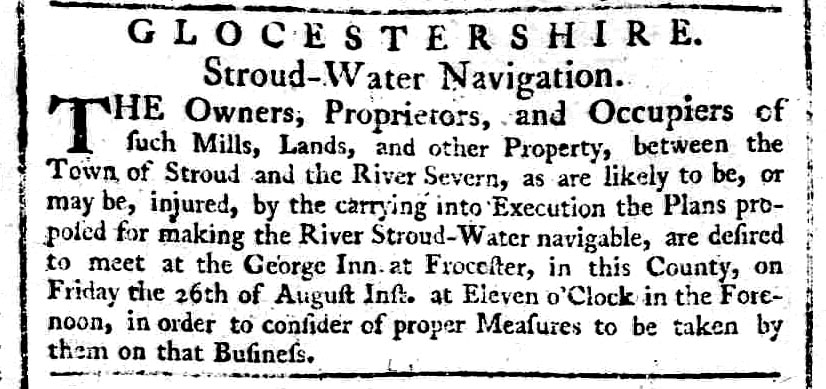
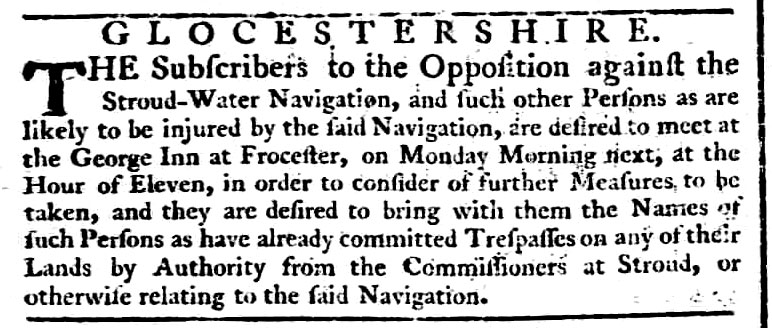
Opponents made clear their determination to obstruct the scheme. Advertisements were placed in the Gloucester Journal inviting those likely to be affected by the scheme to meet together and discuss their responses to the proposed scheme. Some landowners felt the purchase prices offered for their land were inadequate, and some twenty three mill owners below Stroud were concerned about losing water. They presented a petition to Parliament stating, there are upon the said river between Wallbridge and Framiload forty two pairs of stocks, sixteen gigg mills and seven napping mills employed in the woollen manufactory, sixteen pairs of millstones employed in grinding corn and an iron wire mill, a steel wire mill, six pair of rolls for rolling iron, a slitting mill and a rounding hammer for braziers rods employed in the manufacture of iron, all of which are wrought by wheels turned by the water of the said river for which purpose a great force and weight of water is necessary … the said mills upon a moderate calculation afford employment for 5000, and thereby give bread to above 9000 persons and during the summer months in general have not a sufficient supply of water to keep them going more than two thirds and sometimes not more than half of their time; and should the proposed navigation take place it would deprive the petitioners of a great quantity of water, & render the said mills of little use … and the petitioners apprehend that the advantages to arise from the proposed navigation will not be adequate to the injury thereby done to private property … and … will be highly injurious to the woollen & iron manufactures now carried on within the said county to a very considerable extent; and therefore praying that the petitioners may be heard by their counsel, against the said Bill and that the same may not pass into a Law or that they may have such other relief in the promises as to the House shall soon meet.
Rivalries among local clothiers contributed to resentment towards the canal scheme. Opponents to the Bill claimed that millowners above Stroud encouraged the scheme at the expense of clothiers reliant on water from the Frome below Stroud. They claimed that ‘it must bring only profit to the mills above the town which, to be sure, would be for the public good’!
One of the petitioners against the new Bill was Daniel Chance, ‘the elder’, of Rodborough (1706-1782), a third-generation clothier who owned three fulling mills, one corn mill, one gig mill and a dyehouse, with eight drying racks, at Dudbridge. As one of the local gentry and landowners, Daniel Chance was also one of the Commissioners appointed under the 1730 Act.
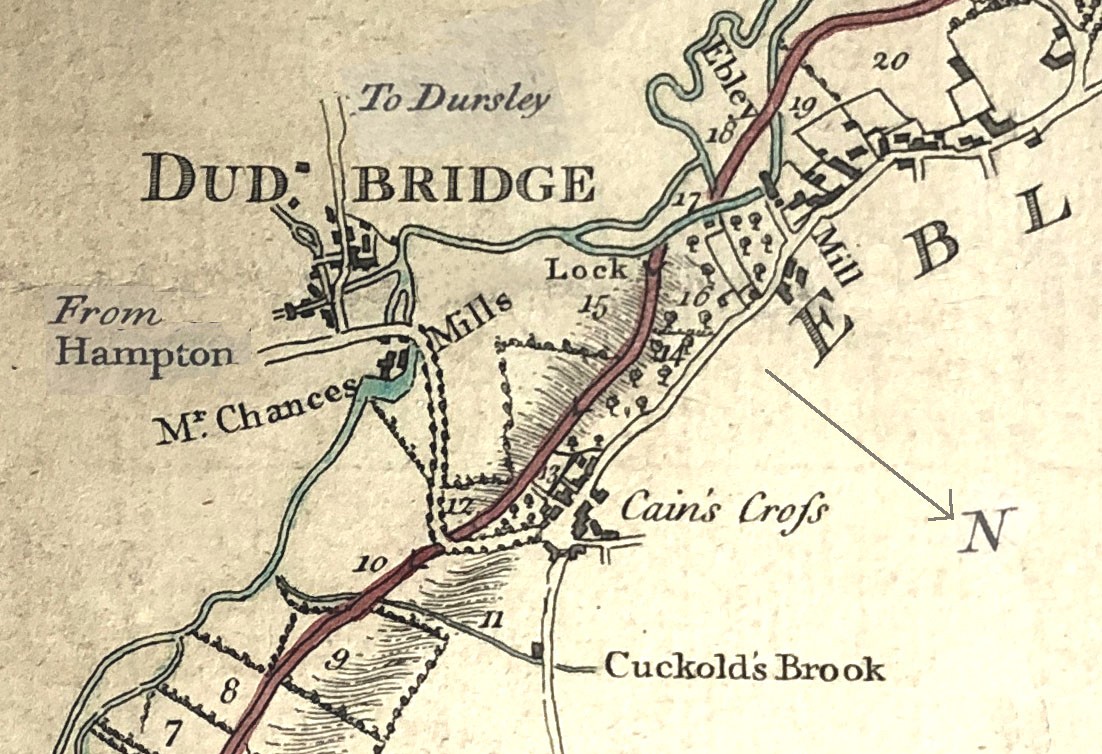
In the planning stages for the Stroudwater Canal, plans were drawn up for the proposed route. A Schedule was compiled detailing the names and residences of all landowners and occupiers along the line of the canal; the nature of their land, whether arable or pasture; the length of the canal crossing each field; and whether the individual concerned supported, opposed, or was neutral towards the proposed scheme. Daniel Chance owned five plots of arable and pasture land straddling the route of the canal (numbered 10, 12, 14, 15 and 16 on the accompanying map). He was recorded as having expressed a ‘neutral’ opinion as regards his view of the intended scheme, signifying that he wanted more assurance as regards the proposed plans and their effects upon his industry.
A separate Schedule was drawn up quantifying the acreage of land intended to be taken into the canal, and its value.
As part of the Parliamentary process for approving a Bill, evidence was taken by the Committee of the House. Daniel Chance, the elder, gave evidence as one of the opposing millowners. He was questioned by Counsel on 8 and 12 February 1776 and gave evidence of his knowledge of the Stroudwater and its nineteen (mainly cloth) mills below Wallbridge. Asked if there was enough water through the year to supply these mills, he replied ‘No, they are obliged to lie by from 3 to 6 months according to the season’. Asked whether the canal could get water from any other source but the Stroudwater or its streams, Daniel said, ‘No – No water can be spared without injury to the mills on the Stroudwater’.
Daniel Chance, who stated he knew the Stroudwater, went on to say, ‘we want all the water we can get but can’t speak to the quantity. [I am] no judge of canals, water runs by on a Sunday but [I do] not call it waste water if some mills stop working, other mills are benefited. People who live above Wallbridge would be benefited. Asked who petitioned for the Bill, Daniel replied ‘chiefly people above Wallbridge’.
Under a programme of lobbying and experimentation for a new Act, the Company of Proprietors proceeded to set about collecting information on the amount of water that ran to waste on Sundays when the mills were not working. Daniel Chance’s millman was interviewed, and he is recorded as having stated, ‘he have been there 38 yeres and believe he remember wen thay could pen the Sundays watter for 12 howers out of the 24 but it was a very remarkable somer mor than 20 yers ago bot ever since that time the watter in the general runs wast most of the day & nights on Sundays’. This seems to suggest there was water to spare on Sundays, though perhaps it was not universally regarded as ‘waste’ water.
Detailed measurements were taken on behalf of the proprietors of the size and capacity of the various millponds, and calculations made of the time taken to fill them. On 29 October 1775, John Bayliss and others, in the presence of Daniel Chance Junior, calculated that Daniel Chance’s millpond filled in eighteen minutes, equivalent to over 3500 locks a day. The following week, on 6 November, it filled in twelve minutes, more than 5000 lockfuls each day. As the demand was only for about twenty locks of water a week, these experiments were relied on to demonstrate that there was more than enough water to work the locks without prejudicing the millowners. It is worth noting, though, that these experiments were conducted in the autumn, not the summer months, which was the period of primary concern to the millowners affected.
John Lawrence, millman at Whitminster Mill, and previously Eastington Mill and a supporter of the canal scheme, reported to the Committee of Directors for the Stroudwater Navigation at their meeting at the George Inn in Stroud on 18 January 1776 Cuckolds Brook empties its self into Mr Daniel Chance’s Mill Pond the third Mill below Walbridge and in the Driest time of Summer he hath seen the whole of this Streame for several Days together & for many Years diverted and turned by a Dam over a Meadow of the said Mr Chance’s to Flood it –
Mr Lawrence clearly seems to be challenging Daniel Chance’s assertions of an inadequacy of water during the summer. This not only demonstrates the divergence of opinion amongst millowners about the scheme and hints at possible hostility between different factions, but might also point to another ground of opposition to the scheme, namely a fear of the loss of fertile meadow land. Perhaps Daniel Chance was diverting water to his adjacent meadow lands for this purpose.
In light of the evidence gathered, promoters of the scheme were so sure of the sufficiency of water that they accepted a clause in the new Bill promising to pay a stipulated fine if taking water for the canal ever interfered with the operation of a mill. This commitment was enough to secure the approval of a new Act in 1776.
There then followed the business of reparation for lands to be taken for the canal. The process to be undertaken was laid down in the Act and was the responsibility of the Commissioners. The Commissioners’ Minute Books record some of the proceedings involved. At a meeting held at Cainscross on 6 November 1777, a board of ten Commissioners determined the amount of purchase monies to be paid to land owners for their lands. In respect of Daniel Chance, it was resolved as follows;
The value of Mr Daniel Chance’s Orchard let to Mr Wm. Hopkins as Tennant, also an Orchard Called Aldershill let to Mr William Jennings as Tennant, also a Meadow called the Moors let to Mr Thomas Turner as Tennant, also a Meadow let to Mr John Hawker as Tennant Situate in the Parish of Stonehouse (intended to be cut thro) We do ascertain and determine to be Seventy Pounds per Acre free of all Taxes Rates and Impositions Whatsoever –
The Value of an Orchard of the sd. Daniel Chance intended to be cut thro’ called Cainscross hill in the sd. Parish of Stonehouse We do ascertain and determine to be One hundred and Eighty Six Pounds Thirteen Shillings and four pence per Acre - free of all Taxes Rates and Impositions Whatsoever –
The value of a piece of Meadow Land of the sd. Daniel Chance intended to be cut thro’ called Dedmarlin situate in the parish of Stroud in the sd. County of Gloucester, We do ascertain and determine to be Eighty Seven Pounds and Ten Shillings per Acre - free of all Taxes Rates and Impositions Whatsoever –
By this time, Daniel Chance the elder was in his 70s and the Company’s solicitor, Mr Lane, recommended to a meeting of Directors on 22 April 1778 that Daniel’s eldest son, Daniel Chance Junior be made a party to any conveyances and receipts, jointly with his father.
On 30 April, brothers Daniel and William Chance attended a Directors’ meeting at the Golden Cross at Cainscross, on behalf of their father, to progress matters as regards lands to be taken for the canal, and an agreement was drawn up. By memorandum, dated 30 April 1778, the Company of Proprietors of the Stroudwater Navigation agreed with Daniel Chance Junior and William Chance to purchase marked out plots of meadow, pasture land and orchards called Dedmarlin, Cainscross Hill, Lower Huntly, Aldershill, and the Moors and to allow the Company’s workmen access on the land ‘for the purpose of making and compleating the said Navigation’. Purchase monies were to be paid to Daniel Chance the Elder.
The Meeting ordered Mr C. Gardner, solicitor, to immediately draw up the requisite conveyances, and the agreed purchase monies to be paid. This was subsequently finalised at a meeting held at the George Inn in Stroud, on 26 August 1778.
In 1778-1780, payments were made to Daniel Chance by Stroudwater Navigation, including for land taken from Dedmarlin and Cainscross Hill, and for damages, including ‘to the two orchards & moors in Dedmarlin; 6 apple trees destroyed in the banks of Dedmarlin; and timber both delivered and left standing’, totalling almost £500.
Daniel Chance Senior died in 1782 before all matters relating to the canal were fully settled.
On 29 March 1783, Daniel Chance (Junior) and William Chance, both of Dudbridge, wrote to Joseph Grazebrook, Clerk to the Commissioners in Stroud,
‘We have Inclosed you our Acct with the Proprietors of the Stroud Water Navigation Compy. For an Abstract of the necessary Titles we beg to refer you to Mr Colborne and shall be glad to have the Acct settled as soon as possible’.
We are Sir, yr very humble servants,
Daniel & William Chance.
Although this may have been intended as a final settlement of outstanding matters relating to the canal scheme, as construction of the canal progressed, there continued to be demands for various pieces of land to be taken into it. For example, at a Meeting of the Committee of the Stroudwater Navigation held on Board the Company’s Barge on Monday 4th June 1787, an agreement was made to exchange a small strip of Land on the side of the foot path leading from the Stone Lock at Dudbridge with Mr Chance for an equal quantity of his Land in order to make the fence straight as the same is now marked out – and the said Foot Road to be turned up into the Turnpike Road at the Wing Wall of the Bridge.
This, and all further dealings in respect of the Stroudwater Navigation were held between the Board of Directors and Daniel Chance, the younger and his brother, William. Both Daniel and William Chance, as landowners in their own right, were appointed Commissioners on 6 November 1777, replacing two Commissioners who had died.
To sum up, therefore, although the Stroudwater Navigation was generally supported by the largest and most powerful millowners of the Stroud valleys, the scheme was thought by others to be a real threat to their livelihoods and the long-established woollen trade of the area. Opposition to the proposed scheme was voiced, in particular, by a number of millowners whose mills were situated on the Frome below Stroud. One of these mill owners was Daniel Chance, the elder. Although far fewer in number and certainly less powerful than the scheme's promoters, the opposers nevertheless exerted significant pressure. Their concerns were such as to affect not only the progress, but also the eventual provisions, of the Act. Daniel Chance, the elder, was an active and influential voice amongst the opponents.
Sources
Handford, Michael, The Stroudwater Canal A History, Amberley, 2013.
Documents held at Gloucester Archives under finding references: D1180/1/1; D1180/1/2; D1180/5/1; D1180/8/2; D1180/10/51; D1180 C1/2, some of which can also be found in the Archives section of this website.